|
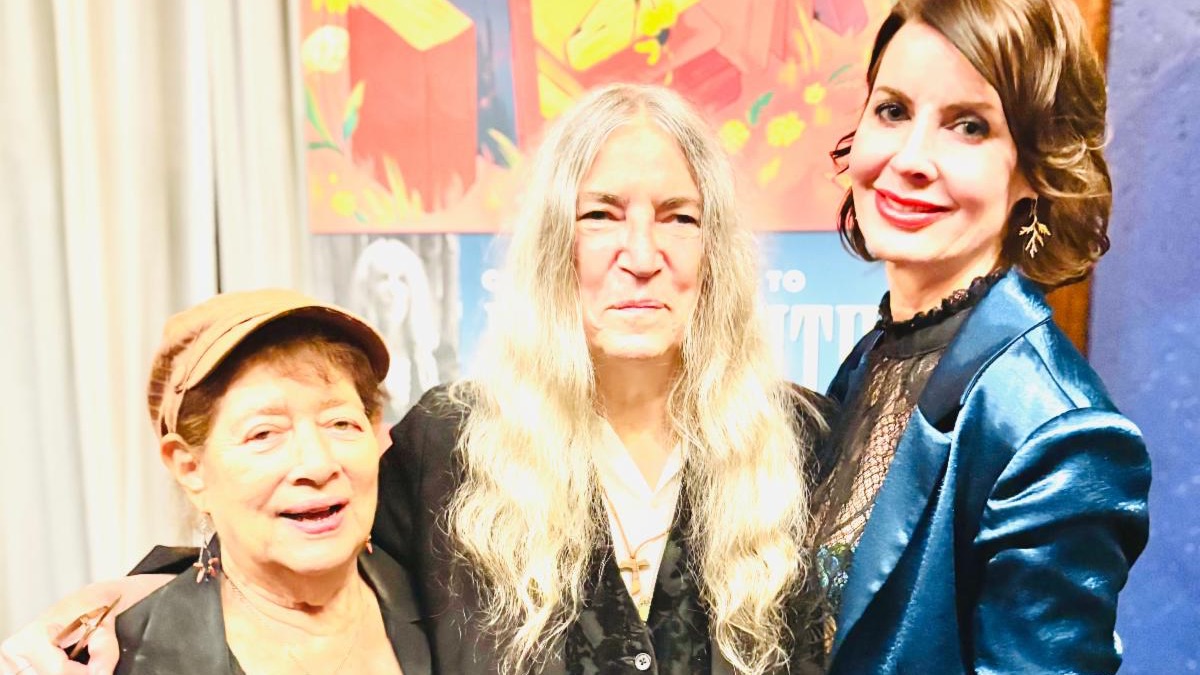
Please bear with me because I’m having a moment here. On more than a few occasions I’ve been in the audience when Patti Smith has been on stage - but I’ve never been on stage when Patti Smith has been in the audience. If there’s something beyond a bucket for Patti Smith fans, this might be it.
A writer, musician, performance artist, and passionate literary citizen, Patti Smith is a true multi-hyphenate. The winner of the National Book Award for her gorgeous portrait of the artist as a young woman, “Just Kids”; the author of a moving new memoir that chronicles her family’s early years in Chicago, “Bread of Angels”; and a 2007 inductee in The Rock ‘n Roll Hall of Fame, Patti Smith is in many ways unparalleled in her career-long commitment to creating deeply literary work across a range of mediums.
Patti seems to recognize that literature is too large to be confined to one genre, too sublime not to be shared in as many ways and places, and with as many different people, as possible.
Her poetry and creative non-fiction - with its distinctive rhythms and unruly energies - feels musical. Her music, not just the lyrics but its actual sound - is poetic. Her literary voice, in every medium she creates in, is distinctly her own.
She writes the past beautifully - in “Bread of Angels” you don’t so much read about her birth during an epic 1946 Chicago snowstorm as you do shiver with it.
But as an author Patti manages the neat trick of being nostalgic without ever seeming sentimental. The lessons her histories impart are always of the now. The recurring themes in her writing - the nexus of loss and love, rebirth, renewal, rising up, reclaiming joy - have never felt more urgent than they do today.
Patti Smith is a writer’s writer, and a rock ‘n roll fan’s writer. But more than anything she is a reader’s writer, by which I mean that she has always been clear about the debt she owes to the literary icons who have come before her.
It’s almost impossible to find a Patti Smith interview in which she does not wax ecstatic about books and authors: Louisa May Alcott. Emily Bronte. William Butler Yeats. Sylvia Plath. My personal favorite, Paul Bowles. Dozens of her songs are inspired by, or pay homage to, the literary greats.
Her recent conversation with the New York Times’s Ezra Klein is a love letter to literature, to libraries, to freedom of speech, to the transformative power - both personal and political - of reading.
Patti understands that for every single one of us, there is a book that can transport us to unknown places, transforming the way that we see the world, and see ourselves.
But first, someone needs to introduce us to that book.
I first discovered Patti Smith the way millions of rock ‘n roll fans have - as a teenager, when a friend’s older sister dropped a needle on Horses, Patti’s iconic 1976 album.
Named one of the “100 Best Records of all Time” by Rolling Stone, it’s a poetry and punk fusion that makes rebellion feel not so much countercultural as culturally necessary. A call to artistic arms that you can dance to.
There’s a track on that record called Land, one in which Patti repeatedly sings the line “Go, Rimbaud, Go,” with a wink and a nod to Chuck Berry’s “Go Johny, Go.”
When I first heard the record, I was struck by the way that Patti sang the name Rimbaud. She did it with such fierce adoration and exuberance that the romantic teenage girl in me assumed that the Rimbaud to whom she refers - which I later learned was Arthur Rimbaud, the French Surrealist poet - must have been Patti’s boyfriend (which in a sense that only we former teenage girls can understand, he kind of was).
The point is that I didn’t learn about Arthur Rimbaud in my high school English Class; Surrealist poets were not in the offing in Wheaton, Illinois. I learned about Rimbaud - and came to appreciate his glorious writing in my own right - through Patti Smith.
In a very real sense, Patti Smith’s debt to her literary forbearers has been her great gift to us, as she pays it forward in the form of her own genre-defying writing.
So thank you, Patti, for the worlds that your words have opened up to me - and to so many of us in this room, and across the globe. Congratulations on being named our 2026 Harold Washington Literary Award winner!
- Anne K. Ream, September 10, 2026.
|